The worst ten minutes of my dog’s life happened on an errand I’d done a hundred times. Seventy-four degrees outside, windows cracked, shade, “I’ll only be a minute.” I came back to a dog panting so hard she couldn’t stand up straight. She was fine. I have never used the words “only a minute” again.
This is dog heat safety in a parked car, written without the part where I pretend to be a veterinarian. Dogs don’t sweat the way we do — they cool mainly through panting, and panting is a lot less effective in a closed box of hot air. That’s the entire problem, and everything below follows from it.
We sell water bowls and not much else in this category, which is a fair place to start: the things that actually help are mostly not products.
Seventy-four degrees outside is not seventy-four degrees inside. That gap is where every summer emergency lives.
Why a parked car is the specific danger
A parked car with the engine off is a glass box with no airflow. The commonly quoted figure is roughly a 20°F rise inside within the first ten minutes, and most of that happens in the first few — but the precise number matters less than the shape of the curve: fast at the start, and still climbing while you’re in line.
Two things make it worse for dogs specifically. Their cooling mechanism (panting) requires moving air that isn’t already saturated and hot, and a closed car gives them exactly that. And the breeds most people love — flat-faced dogs, thick-coated dogs, senior dogs — are the least equipped to handle it.
Cracking the windows is the single most repeated mistake. It’s not nothing, but tested against a closed car it buys you very little time, and it buys almost none on a still, sunny day.
The rule that prevents almost all of it
If you can’t take the dog, don’t take the dog.
That’s the whole rule, and every workaround is a compromise with it. But since life is life, here’s the ranking of compromises from least bad to worst:
Best: a second human waits in the car with the engine and air conditioning running.
Acceptable in mild weather only: parked in real shade, engine running, air conditioning on, windows up, dog on the side away from the sun, and you can see the car from where you’re standing. Under ten minutes.
Not acceptable: windows cracked, engine off, “it’s only seventy degrees,” any amount of time in direct sun, and any scenario where you can’t see the car.
Notice that shade moves. A spot that’s shaded when you park is in full sun forty minutes later, and your dog doesn’t get to move the car.
What actually helps, in order
1. Water you can reach without unpacking anything. Not water in the trunk. Water in the door pocket, in a bowl that lives there. This is the highest-value item on the list by a wide margin.
2. Airflow while the car is moving. Rear vents, or windows down enough to move air across the dog — not just open an inch.
3. Timing. Before 10 a.m. and after 6 p.m. in peak summer. The middle of the day is where emergencies live, and most of them are errands that could have waited.
4. Surface awareness. A dog standing on hot cargo-area metal or a dark seat cover in July is picking up heat from below as well as around. Light-coloured covers and a blanket matter more than people think.
5. Knowing the early signs. Hard, frantic panting; bright red gums or tongue; thick sticky saliva; staggering; glazed eyes. Any of those and it’s water, shade, cool surfaces and a vet — in that order, without waiting to see if it passes.
What doesn’t help much
Cooling vests help in dry heat and help much less in humidity, because most of them work by evaporation. Bandanas and “cooling pads” are close to props unless they’re actively re-wetted. And fans blowing hot air over a dog in a hot car are moving the problem around, not removing it.
The honest summary: there is no product that makes it safe to leave a dog in a hot parked car. There are only products that make a moving car more comfortable.
What’s worth keeping in the car
Collapsible travel bowl, 2-pack — $7.60
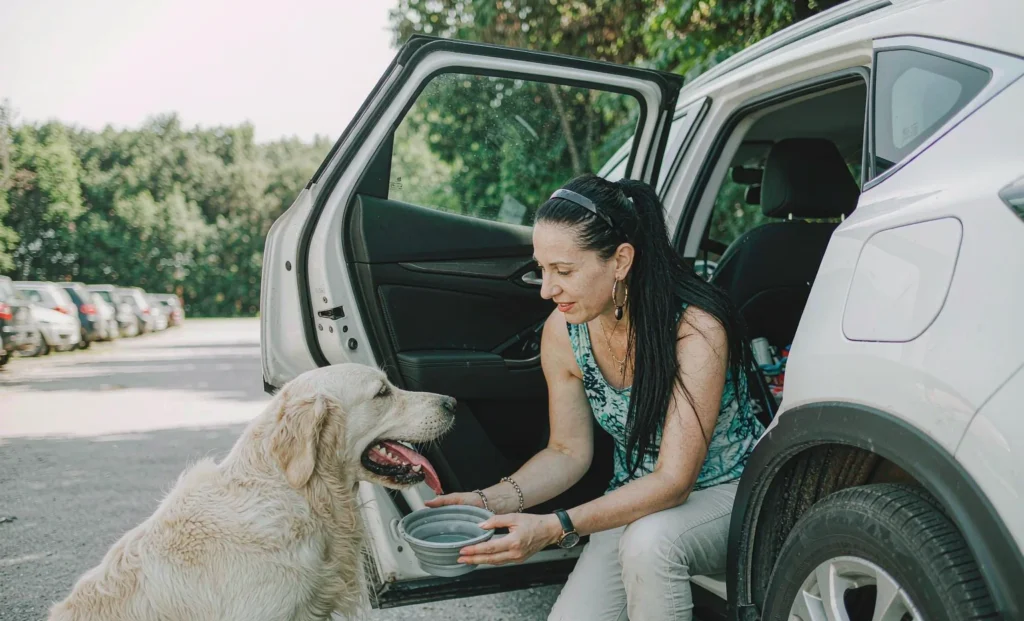
The only thing on this list I’d call mandatory. One lives in the door pocket, full, all summer. Silicone, collapses flat, clips to anything. A dog who can drink on demand is a different animal from a dog who can’t.
Hands-free bungee leash — $15.80
For the walk from the shade to the door and back. Bungee takes the jerk out of a dog who pulls toward grass, and having both hands free matters when one of them is holding water.
Breathable mesh harness — $25.60
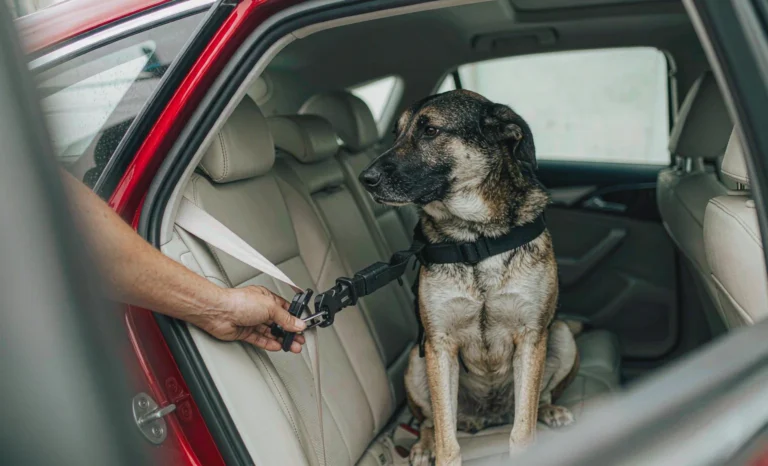
July is not the month for a padded nylon harness. Mesh lets air through the panels that sit against the chest, which is where a dog carries the most heat.
Quilted rear bench cover — $33.60
A light-coloured, breathable surface instead of dark fabric or vinyl in direct sun. It’s a small difference in temperature and a large one in how willing your dog is to lie down.
Test I use now: before I leave the car, I put the back of my hand on the surface my dog is standing on. If I can’t hold it there for five seconds, the car is not a place to leave anybody. It takes two seconds and it has changed my mind more than once.
Common questions
Is it safe to leave a dog in the car with the windows cracked?
On a mild, overcast day for a few minutes, usually survivable — but cracked windows are much less protection than people assume, and the temperature inside keeps climbing while you’re gone. Treat it as a small margin, not a safety measure.
How hot is too hot for a dog in a car?
There isn’t a number, because humidity, breed, coat, age and airflow all move it. What’s reliable is behaviour: if your dog is panting hard before you’ve even parked, the car is already working against them.
Do cooling mats work?
Gel mats help for a while and then match the ambient temperature, at which point they’re just a surface. They’re a comfort item for a moving car, not a solution for a parked one.
What should I do if I see a dog in a hot car?
Note the location, the make and the plate, and get store staff to page the owner. If the dog is showing the signs listed above, call local animal control or police — in many states there are Good Samaritan provisions, but the law varies, so know yours before you’re standing there.
Read next: cold mornings, warm dogs · cargo area or back seat. More hard rides in Drive Together, and more buying guides in the Gear Lab. Filed under daily and road trip.