I bought my first dog car restraint because a listing used the word “crash-tested.” I bought my second one three months later, after the first turned out to be a strap my dog could back out of in four seconds flat. The second one is still in the car, five years on.
Choosing a dog car restraint is confusing mostly because the category is sold on fear and certified on almost nothing. So here’s the honest version: what the three options actually do, what they don’t, and the one question that will decide it faster than any spec sheet.
We sell all three types. We don’t run crash tests and we don’t publish crash ratings. What follows is about fit, behaviour and everyday use — which is where most restraints actually succeed or fail.
A restraint your dog can back out of is not a restraint. It’s a prop that makes you feel like you did something.
The three options, plainly
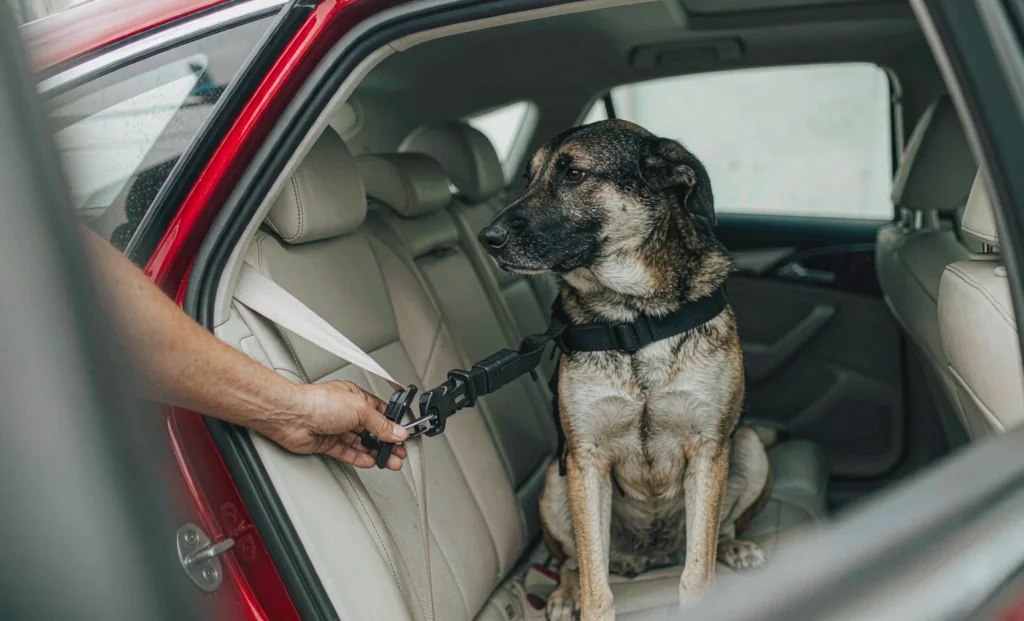
A harness goes on the dog and clips into the seat belt buckle or a tether. It keeps them on the seat, stops them reaching the front, and gives you a handle. It does not keep a small dog off the floor, and a determined escape artist will learn to reverse out of a loose one.
A tether is the short strap between the harness and the anchor. Sometimes sold separately, usually included. Its job is length control — long enough to lie down, short enough not to reach the driver. Too long is worse than none.
A crate contains the dog entirely. It’s the most complete answer and the least convenient one, because it’s a large object that lives in your car whether or not the dog does.
The question that decides it
Ask this: what is my dog actually going to do back there?
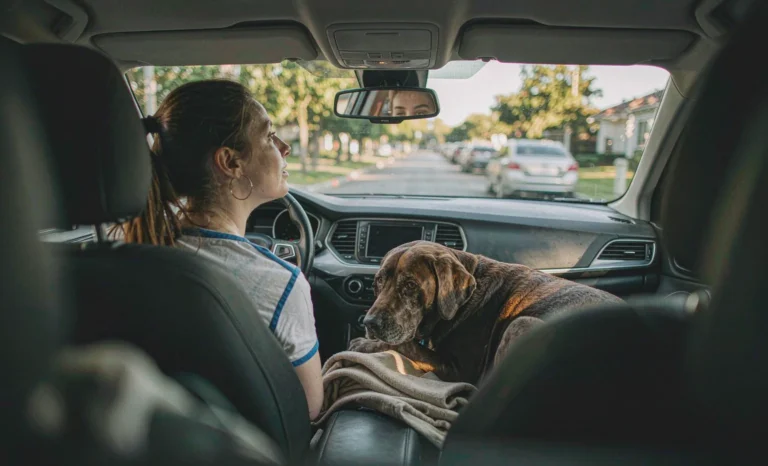
A dog who lies down and sleeps needs almost nothing — a harness for the last five minutes of the trip, mostly so they don’t launch themselves at the door when you park. A dog who stands, turns, paces and re-sits for forty minutes needs a crate or a very short tether, because motion is the problem, not travel. A dog who tries to get to you needs a barrier more than a restraint.
That single answer eliminates two of the three options most of the time. People skip it because it requires admitting what their dog is actually like.
How to read crash-test claims honestly
Here’s what nobody in this category likes to say out loud. There is no widely accepted, independently published crash-test standard for dog restraints in the United States the way there is for child seats. When a listing says “crash-tested,” it usually means one of three things: the manufacturer ran its own test, a third party ran a test to an unpublished protocol, or the phrase is doing marketing work.
That doesn’t make the products useless. A well-built harness attached to a seat belt buckle keeps a dog off your lap at 60 mph, and that is worth a great deal. But if a specific rating matters to you, ask the manufacturer for the report and the protocol before you rely on it — and treat “we don’t have one” as an answer rather than a shrug.
We sell one crate marketed as a crash-tested frame. We don’t publish a rating ourselves, and we’d rather tell you that than borrow someone else’s number.
Fitting it properly
Most restraint failures are fit failures, not product failures.
Two fingers. That’s the gap you want under every strap. Tighter than that and it rubs; looser and it’s an exit route.
Check the escape route weekly. Dogs change shape with coat, weight and season. A harness that fit in February is often loose in June.
Anchor to the frame, not the fabric. The seat belt buckle is the anchor. A strap looped around a headrest post is not, and it will tell you so the first time you brake hard.
Short is safe, shorter is calmer. Most tethers ship too long. If your dog can reach the front seat, shorten it.
What we’d actually put in the car
No-pull outdoor harness — $29.80
Four adjustment points, which is the whole argument. A two-point harness fits one shape of dog; this one fits the dog you have through a coat change and a weight change. Padded, reflective, top handle for curbs.
Breathable mesh harness — $25.60
The one for hot months and long wear. Mesh backs down to almost nothing, and if the dog wears it for the whole drive it has to be comfortable enough to forget about.
Heavy-duty training harness — $33.00
For pullers and big dogs, sizes up to XXL. Dual attachment points so you can anchor front or back depending on whether the dog is a leaning-puller or a lurching-puller.
Folding travel crate — $59.60
If your answer to the question above was “he paces,” this is the answer. Steel frame, fabric shell, sets up in seconds and folds flat — the version of a crate that survives living in a car.
The thirty-second test: clip the dog in, walk round to the driver’s door, and get in. If you can reach them from the seat, the tether is too long. If you can’t reach them at all, it’s too short or they’re in the wrong place.
Common questions
Is it illegal to drive with an unrestrained dog?
It varies by state. Several states have distracted-driving laws that have been applied to unrestrained pets, and a handful address restraint directly. Check your state before assuming you’re fine — and note that “legal” and “safe” are different thresholds.
Can I just clip a leash to the seat belt?
You can, and it’s better than nothing. But a leash clip is not designed for load in a stop, and the collar taking that load is your dog’s neck. A harness spreads it across the chest, which is the entire point.
What about small dogs in a carrier?
A soft carrier on the seat, seat-belted in, is a legitimate answer for a dog under about 15 pounds — and usually calmer than a harness for that size. Just make sure the carrier itself is strapped down, not just sitting there.
Read next: cargo area or back seat · the everyday dog kit audit. Compare everything in the Gear Lab, or start from Drive Together. More in daily.