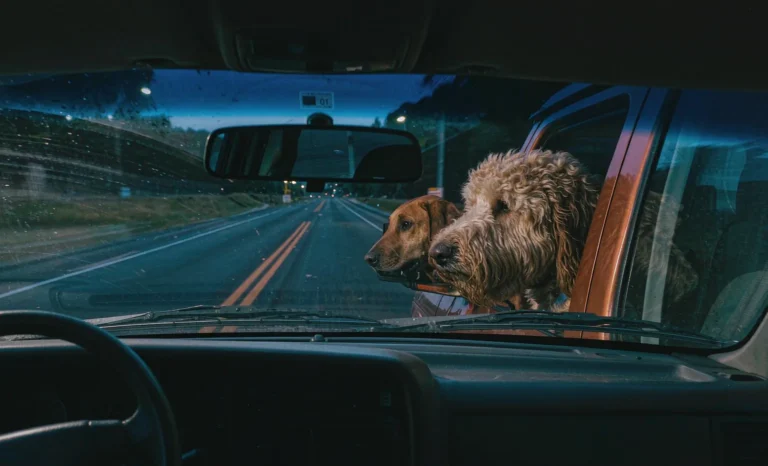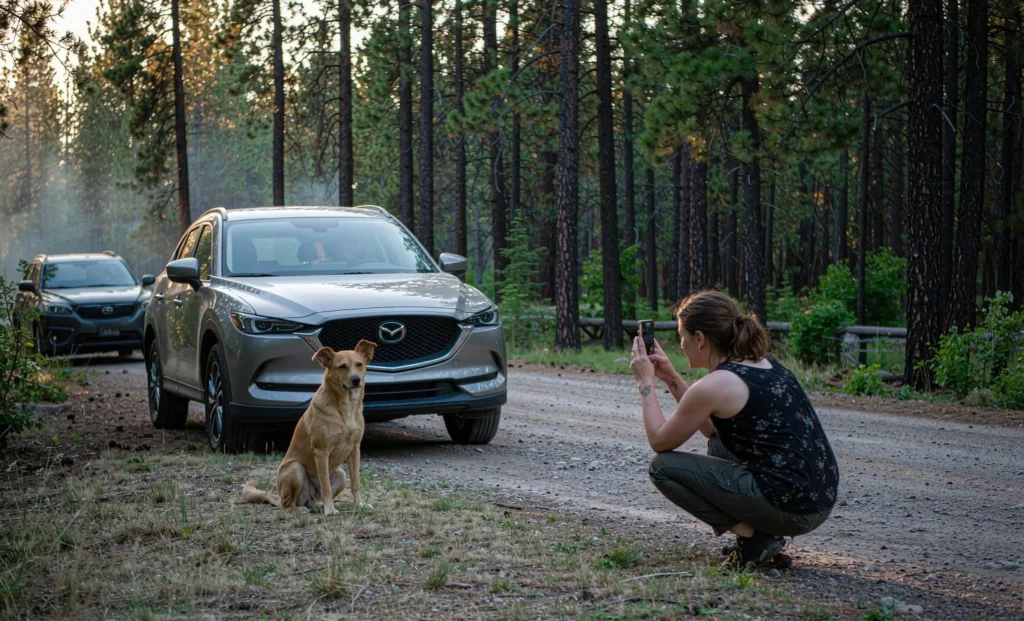
I have exactly two good photographs from the first three years of driving with my dog, and both were accidents. Then I learned four things about phone cameras and started coming home with pictures I actually print. No gear, no editing suite — just four habits and a dog who has learned that sitting still produces treats.
This is a phone-only guide to dog road trip photography, written for people who don’t want to carry a camera.
The best dog photo of the trip is almost never the one you posed.
Habit one: get down to her height
Every bad dog photo is taken from standing height. Kneel, or sit on the ground, or put the phone on the tailgate at nose level — suddenly your dog has a face instead of a forehead and a back. It’s the single change that separates a snapshot from a photograph, and it costs nothing but a muddy knee.
Habit two: light from behind, early or late
Midday sun is a photographer’s problem and a dog’s problem — squinting, harsh shadows, and a dog who wants shade. Shoot in the first two hours after sunrise and the last two before sunset, and put the sun behind her when you can. Backlit fur, dust in the air, and a dog who looks like she’s having the time of her life: that’s the whole aesthetic, and it’s free.
Habit three: stop for three shots only
Three, every trip. One at the trailhead or the campsite sign — the we’re here frame. One in motion: her running at the camera on a wide path, taken in burst mode, keeping the sharp one. One quiet one: her asleep in the cargo area with the door open, light falling across the liner. That’s a complete story of the trip in three frames.
Habit four: make the car part of the picture
The open tailgate is the best photo studio you own — shade, a neutral background, and a surface you can put a dog on. A clean, non-slip cargo liner reads as a deliberate set rather than a messy trunk, and a small bowl or a coiled leash in frame tells the viewer what kind of day it was. The car is context, never the subject — this is a dog story that happens to have a vehicle in it.
Two phone settings that matter: turn on grid lines so the horizon is actually level, and use burst mode for anything that moves. Dogs blink, ears shift, and one of fifteen frames will be the one where she looks like herself.
What to do with them
Pick nine. Print them, or put them in one folder per season. Trips blur together, but a folder of nine frames from each one is the closest thing to a diary most of us will ever keep — and it’s the reason the first real trail or the first long drive stays vivid a year later.
Questions about photographing dogs on trips
How do I get my dog to look at the camera?
Don’t chase it. Set her up, wait, and use a sound she only hears on special occasions — one short noise, one frame, then reward. A dog who expects a treat after the sound will look at you every time.
Is a phone good enough for dog photography?
For everything except fast action in low light, yes. Modern phones handle backlit fur and motion bursts well; the limitations are the photographer’s, not the camera’s.
What’s the easiest way to shoot a moving dog?
Burst mode, plenty of light, and shoot along the path rather than across it so the dog stays in focus through the frame.
Read next: the first real trail · the coast drive. More in trail and road trip, or browse the season boxes.
More from Screen & Story
Part of the Field Journal · Drive Together · Explore Together · Gear Lab · Season Boxes