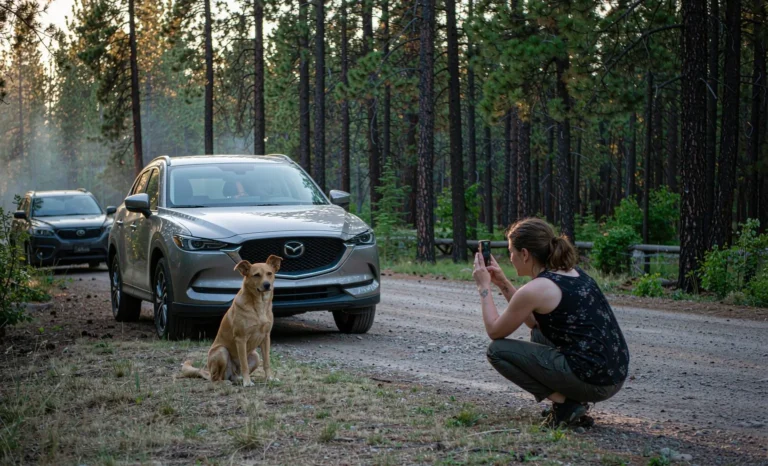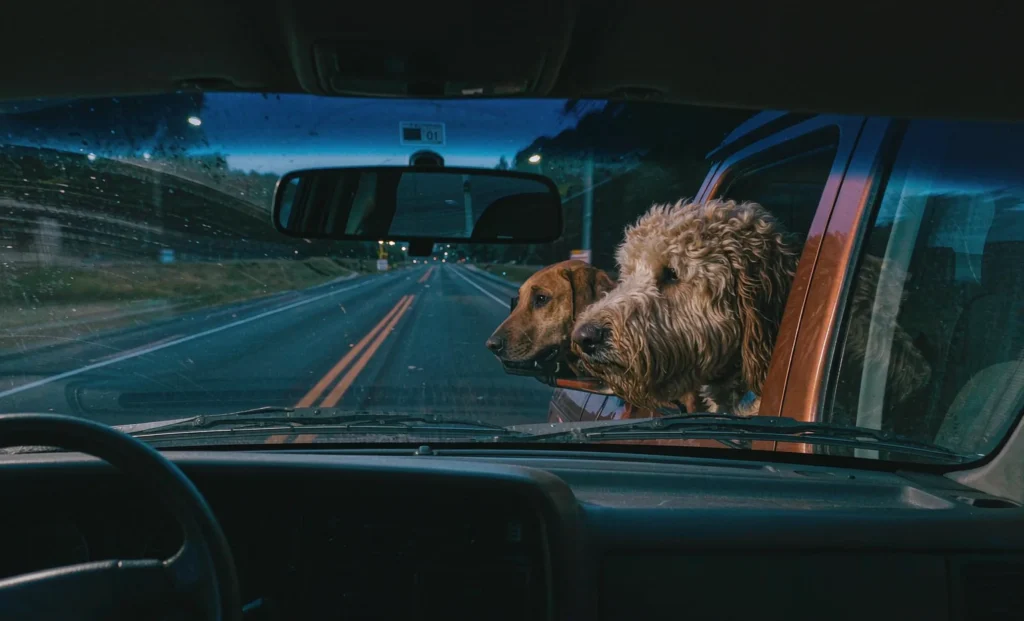
There’s a shot every American road movie owns: the dog in the passenger seat, head out the window, ears flat, the highway unspooling behind. It shows up in comedies, in indie dramas, in the one you watched on a plane and immediately texted someone about. We keep returning to it because it’s true — and because it’s the cheapest way a filmmaker can tell you these two are in this together.
Here’s what dog road trip movies understand about travelling with a dog, and the one thing they consistently get wrong.
The dog is never the plot. The dog is the proof that the journey mattered.
They understand the dog as a reason, not a prop
In the good ones, nobody drives across the country because the dog wants to. The dog is the reason the trip has a shape: you stop because she needs to, you take the slower road, you end up in the town you didn’t plan on. That’s not sentimentality, that’s mechanics — a dog forces stops, and stops are where the story happens. Anybody who has driven six hours with a dog has lived this. It’s the same reason my own coast drive is mostly a list of rest stops.
They understand the car as a room
Watch how these films frame a car: not as a vehicle but as a small room with two people and one animal in it, where everything important gets said. It’s why the dog-in-the-window shot works — it’s a room with a view, and the dog is the one enjoying it. We build for that room too: a surface that doesn’t slide, a bowl within reach of the driver’s seat, and a chew for the last hour — the hour the movie never shows.
They understand that arrival is anticlimactic
The best road movies end quietly, with the arrival almost an afterthought. That’s accurate. Ask anyone who has done a long drive with a dog: the memory is the 4 p.m. stretch of highway and the dog asleep in the back, not the destination. Which is why the load-out matters — the less friction at the start, the more of the trip you actually get to remember.
And the one thing they always get wrong
The dog in the front seat, unrestrained, sometimes with her paws on the wheel. It plays beautifully and it’s the single worst habit these films teach. A loose dog in the front seat is a projectile in a crash and a distraction on every other drive — the movies have been selling this shot for fifty years, and it’s the reason so many people think it’s normal.
The good news is that the safe version looks just as good. A dog in a crash-tested crate in the cargo area, or in a harness tethered in the back, still gets the window, the wind and the whole American horizon. The shot doesn’t change. Only the odds do.
A viewing list, if you want one: the ones worth watching are the ones where the dog changes the trip rather than accompanies it — the quiet indie road dramas, the family films where the dog is why everyone keeps talking to each other, and the occasional animated one that gets the window shot exactly right.
Questions people ask about dogs in road movies
Why are dogs in so many road trip movies?
Because a dog solves a story problem: it justifies stopping, softens the characters, and gives the journey a reason to be slow. Filmmakers use dogs the way real drivers do — as permission to take the long way.
Is it really unsafe for a dog to ride in the front seat?
Yes. Airbags, distraction, and the risk of a dog becoming a projectile in a collision. Back seat with a harness tether, or a crash-tested crate in the cargo area, are the two setups worth copying.
Read next: the six-hour drive · the Saturday loop. More in road trip, or see what we pack in the season boxes.
More from Screen & Story
Part of the Field Journal · Drive Together · Explore Together · Gear Lab · Season Boxes